How Big Is the Average Family in Papua New Guinea
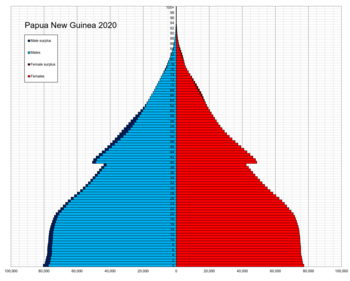
The indigenous population of Papua New Guinea is one of the well-nigh heterogeneous in the world. Papua New Guinea has several m dissever communities, nearly with only a few hundred people. Divided by language, customs, and tradition, some of these communities have engaged in endemic warfare with their neighbors for centuries. Information technology is the second well-nigh populous nation in Oceania.
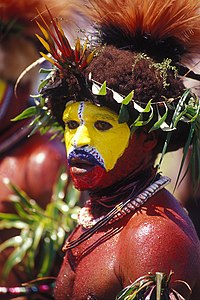
The isolation created past the mountainous terrain is so cracking that some groups, until recently, were unaware of the beingness of neighboring groups but a few kilometers away. The diversity, reflected in a folk proverb, "For each village, a different culture", is possibly best shown in the local languages. Spoken mainly on the island of New Guinea, almost 650 of these Papuan languages have been identified; of these, only 350-450 are related[ citation needed ]. The balance of the Papuan languages seem to be totally unrelated either to each other or to the other major groupings. In addition, many languages belonging to Austronesian language group are used in Papua New Guinea, and in total, more than 800 languages are spoken in Papua New Guinea.[1] Native languages are spoken by a few hundred to a few chiliad, although Enga language, used in Enga Province, is spoken by some 130,000 people.
Tok Pisin serves equally the lingua franca. English is the linguistic communication of business organization and government, and all schooling from Form 2 Main is in English.
The overall population density is low, although pockets of overpopulation exist. Papua New Guinea's Western Province averages one person per foursquare kilometer (3 per sq. mi.). The Simbu Province in the New Guinea highlands averages twenty persons per square kilometer (60 per sq. mi.) and has areas containing up to 200 people farming a square kilometer of land. The highlands accept xl% of the population.
A considerable urban drift towards Port Moresby and other major centers has occurred in recent years. Between 1978 and 1988, Port Moresby grew nigh eight% per year, Lae 6%, Mount Hagen 6.5%, Goroka 4%, and Madang iii%. The tendency toward urbanization accelerated in the 1990s, bringing in its wake squatter settlements, unemployment, and attendant social bug. Almost 2-thirds of the population is Christian. Of these, more than than 700,000 are Roman Catholic, more 500,000 Lutheran, and the balance are members of other Protestant denominations. Although the major churches are under indigenous leadership, a large number of missionaries remain in the country. The non-Christian portion of the indigenous population practices a broad variety of indigenous religions that are an integral office of traditional culture. These religions are mainly types of animism and veneration of the expressionless.
Foreign residents are simply over one% of the population of Papua New Guinea.[ citation needed ] More than half are Australian; others are from the U.k., New Zealand, the Philippines, Zimbabwe and the United States.[ commendation needed ] Since independence, most 900 foreigners take get naturalized citizens.[ commendation needed ] Over 100,000 white people live in Papua New Guinea, representing over one% of its total population.[ citation needed ] Most of them are from Australia.[ commendation needed ] An estimated 20,000 Chinese people live in Papua New Guinea.[2]
The traditional Papua New Guinea social structure includes the following characteristics:
- The practice of subsistence economy;
- Recognition of bonds of kinship with obligations extending beyond the immediate family unit group;
- Generally egalitarian relationships with an accent on caused, rather than inherited, condition; and
- A strong attachment of the people to land.
Most Papua New Guineans even so adhere strongly to this traditional social construction, which has its roots in village life.
Fertility and births [edit]
Full Fertility Rate (TFR) (Wanted Fertility Rate) and Rough Birth Rate (CBR):[3]
| Yr | CBR (Total) | TFR (Total) | CBR (Urban) | TFR (Urban) | CBR (Rural) | TFR (Rural) |
|---|---|---|---|---|---|---|
| 2016-18 | 29 | 4.two (3.0) | 28 | 3.5 (2.6) | 29 | 4.3 (3.1) |
Vital statistics [edit]
Births and deaths [4]
| Yr | Population | Alive births | Deaths | Natural increase | Crude nascence rate | Crude expiry charge per unit | Rate of natural increment | TFR |
|---|---|---|---|---|---|---|---|---|
| 1980 | iii,010,727 | |||||||
| 1990 | 3,761,954 | |||||||
| 2000 | 5,190,786 | 36.i | 11.8 | 24.3 | 4.8 | |||
| 2011 | seven,275,324 |
CIA demographic statistics [edit]

Demographics of Papua New Guinea, Data of FAO, year 2005; Number of inhabitants in thousands.
The following demographic statistics are from the CIA Globe Factbook 2015 [five]
Population [edit]
- 8.seven one thousand thousand
Age structure [edit]
- 0–14 years: 34.45% (male i,169,870/female 1,128,631)
- xv–24 years: 19.77% (male 668,327/female 650,672)
- 25–54 years: 36.43% (male 1,253,827/female ane,177,004)
- 55–64 years: 5.iii% (male 179,075/female 174,721)
- 65 years and over: 4.05% (male 139,060/female person 131,242) (2015 est.)
Population growth rate [edit]
- 1.78%
Birth charge per unit [edit]
- 24.38 births/1,000 population
Death rate [edit]
- six.53 deaths/1,000 population (2015 est.)
Cyberspace migration rate [edit]
- 0 migrant(s)/ane,000 population (2015 est.)
Sex ratio [edit]
- At birth: ane.05 male(south)/female
- 0–xiv years: i.04 male(due south)/female
- 15–24 years: ane.03 male(s)/female
- 25–54 years: 1.07 male person(s)/female
- 55–64 years: ane.03 male(s)/female
- 65 years and over: i.06 male(s)/female
- Full Population: ane.05 male(s)/female (2015 est.)
Maternal bloodshed ratio [edit]
- 215 deaths/100,000 live births
Infant mortality rate [edit]
- Total: 38.55 deaths/1,000 live births
- Male: 42.12 deaths/one,000 alive births
- Female: 34.81 deaths/one,000 live births (2015 est.)
Total fertility charge per unit [edit]
- iii.x children built-in/woman (2016 est.)
Nationality [edit]
- Papua New Guineans (noun)
- Papua New Guinean (describing word)
Ethnic groups [edit]
- Melanesians
- Papuans
- Negritos
- Micronesians
- Polynesians
Religions [edit]
- Roman Cosmic 27%
- Protestant 69.4%
- Evangelical Lutheran xix.v%
- United Church 11.v%,
- Seventh-Day Adventist 10%
- Pentecostal 8.six%
- Evangelical Alliance five.2%
- Anglican 3.2%
- Baptists ii.5%
- Other Protestant 8.ix%,
- Baháʼí 0.3%,
- Ethnic beliefs and other 3.3%
Languages [edit]
- Tok Pisin (official)
- English (official)
- Hiri Motu (official)
Literacy [edit]
- Total population: 64.two%
- Male: 65.vi%
- Female person: 62.eight%
See as well [edit]
- Papua New Guinea
- Port Moresby
References [edit]
- ^ "Papua New Guinea - Ethnologue".
- ^ "Syndicate spending $414m on Chinatown in Port Moresby as battle for PNG influence escalates". ABC. 2019-04-xvi.
- ^ "Error Occurred While Processing Request".
- ^ https://png-data.sprep.org/dataset/2011-census-report/resources/685645cd-0aa9-46b2-9670-a68aeb0cc8ae [ dead link ]
- ^ "Due east & Southeast Asia :: PAPUA NEW GUINEA". CIA The World Factbook. vii December 2021.
Source: https://en.wikipedia.org/wiki/Demographics_of_Papua_New_Guinea

Post a Comment for "How Big Is the Average Family in Papua New Guinea"