How Many Lbs of Beef Are Ate Each Year
Burgers, bacon, steaks, and other meat products accept come up under scrutiny in contempo years due to their impact on wellness, sustainability, and social justice issues. The number of companies working on meat alternatives in the U.Southward. is growing. Half of U.S. consumers nether the age of 50 take already tried a plant-based meat product. Even so meat consumption in the U.S. is on the rise. As of 2017, America had the second-highest meat consumption in the world, surpassed only by Hong Kong. How much meat practise Americans swallow, and what are the impacts of their meat consumption?
How Much Meat Is Consumed in the U.S.?
Americans consume effectually 274 pounds of meat per yr on average, not accounting for seafood and fish, or individual food waste material. The total amount of meat consumed in the U.S. has increased by forty percentage since 1961. In 2017, the U.S. Department of Agriculture (USDA) reported that Americans are exceeding the amount of meat recommended by national dietary guidelines, although women in the U.S. eat about a third less meat than men, and effectually 42 percent less beef.
Beefiness and Veal
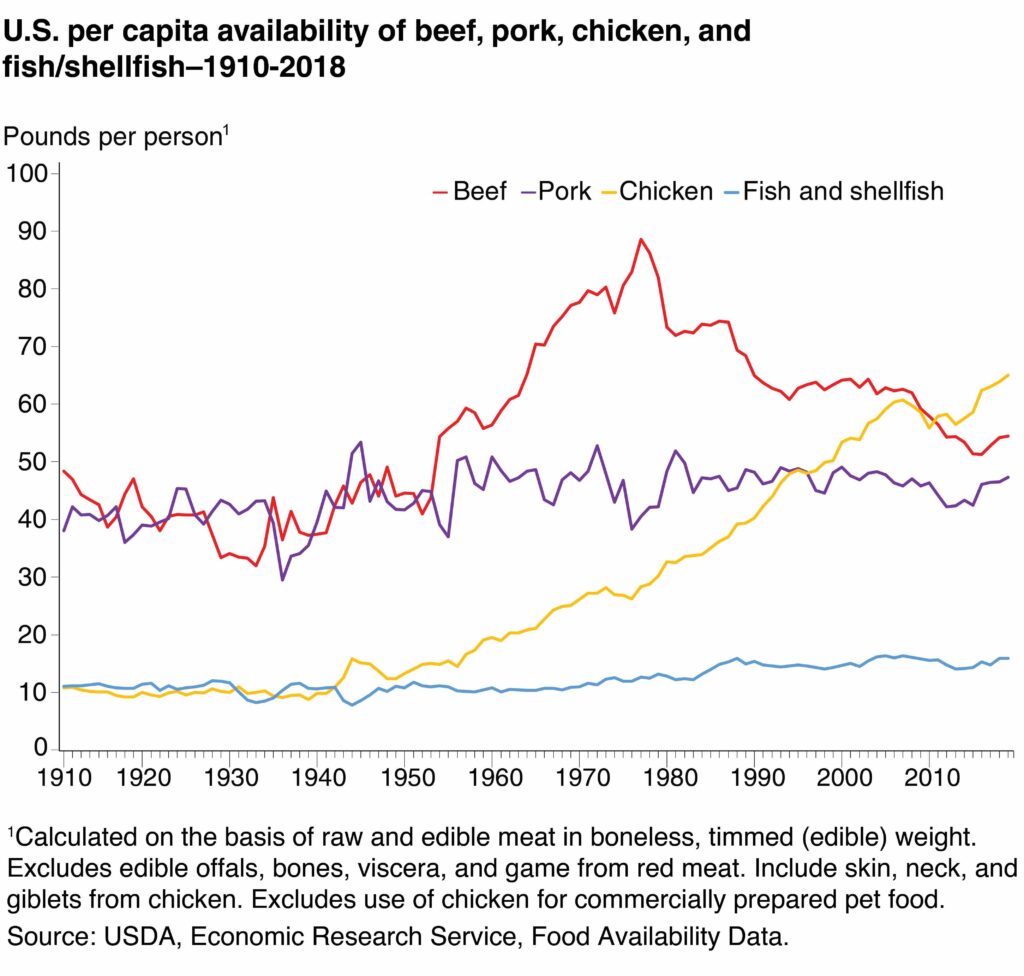
The U.S. has the globe'due south 2d-highest consumption of beef and buffalo after Argentine republic. In 2017 Americans consumed 81.74 pounds of beef and buffalo per capita, a 37 percent decrease from 1976, when Americans had reached a tape consumption of 129.65 pounds per capita. In the late 1970s beef consumption started falling, due to scientific findings apropos the health impacts of saturated fats. In 2013 beef and buffalo consumption in the U.S. had dropped to nether 80 pounds per capita, but then started rising again.
Pork
Pork consumption in the U.S. fluctuated betwixt 72.64 and 53.19 pounds per capita between 1961 and 2017. The latest data shows that Americans eat an annual 66.eighteen pounds of pork per capita. The U.Due south. Demography information and Simmons National Consumer Survey (NHCS) plant that 268 one thousand thousand Americans ate salary in 2020, with over 16 1000000 eating five pounds of bacon or more than during the year.
Poultry
Poultry is divers as domestic fowl, including chickens, turkeys, and geese. In 2017 Americans consumed a record 122.75 pounds of poultry per capita. According to the USDA, chicken consumption has increased by 540 percent since 1910, from around 10.i pounds per capita to 65.2 pounds in 2018. Since 1961 the consumption of poultry has more than tripled.
The growing popularity of chicken in the U.S. is linked to beef falling out of favor. For decades, consumers have been choosing chicken over beef due to health and ecology concerns; even so, eating farmed chickens has besides been shown to be problematic for several reasons.
Lamb
Since the 1960s the consumption of lamb and mutton in the U.Southward. has fallen from near 5 pounds to about one pound per capita. Most xx percent of lamb consumption in the U.S. occurs during the spring holidays. Urban consumers are more likely to eat lamb than consumers based in rural areas.
What Is the Most Consumed Meat in the U.S.?
Over the terminal three decades, chicken overtook beefiness and pork to become the nigh commonly consumed meat product in the U.S. In 2020 Americans ate 96.four pounds of broiler chickens per capita. Co-ordinate to information by the USDA and Economic Research Service, Americans are expected to eat 101.1 pounds of broiler chickens per capita by 2030.
Is Meat Consumption Increasing or Decreasing?
Meat consumption in the U.S. increased by 40 pct between 1961 and 2017. Globally, meat consumption increased by 58 pct between 1998 and 2018.
U.South. meat consumption is expected to increase past one percent each year through 2023, according to the contempo Packaged Facts report Global Meat & Poultry Trends. While consumption of broiler chickens and pork is expected to rise, Americans are expected to eat slightly smaller amounts of beef and turkey by 2030.
Is the Meat Manufacture Dying?
The number of Americans identifying every bit vegetarians has remained roughly the same at half-dozen pct since 1999, co-ordinate to Gallup surveys. The number of self-identifying vegans increased from only 2 to three percentage between 2012 and 2018. Nonetheless, and despite projections of growing meat consumption, 23 percent of Americans reported reducing the corporeality of meat they ate in 2019. The number of U.S. consumers who have tried establish-based alternatives has also risen to seventy percent.
Investment firm UBS predicts that annual sales in the found-based meat market will grow from $iv.6 billion in 2018 to $85 billion in 2030. Co-ordinate to global consultancy AT Kearney, 60 pct of meat eaten globally in 2040 will be from institute-based or lab-grown alternatives. In response to changing consumer preferences, traditional meat producers are increasingly calculation found-based alternatives to their product ranges. A 2021 written report found that the average American believes that the U.Southward. could get completely constitute-based by 2039. Yet when faced with falling local demand, some meat companies instead resort to increasing their exports to countries with ascent meat consumption levels. In September 2020, for example, the U.S. pork industry exported a record 29 percent of full pork production to buyers outside the U.Southward.
How Much Meat Is Wasted in the U.Due south.?
According to a 2020 report, Americans waste effectually a third of the food they purchase, costing the average household $1,866 per year, or $240 billion for the whole population. Fresh meat requires processing, and is a highly perishable production, which increases the likelihood of waste material.
The USDA estimates that only half of the body of a slaughtered cow, hog, lamb, chicken, or turkey ends upward being eaten. Beef, for example, can be wasted equally it moves from farm to retail due to damage during packaging, inadequate storage, or when inspectors reject it for safety reasons. Within retail, packaging failures, colour changes, spoilage, and overstocking tin can all crusade further loss. At the consumer level beef can be wasted due to inadequate storage, spoilage, recalls, and when consumers prepare more beef than they ultimately consume.
Taking the number of farmed animals who die before slaughter into account, the amount of meat wasted in the U.S. is even college. According to Iowa Land University, an estimated 1 out of 3 pigs born into the U.S. pork industry dies before slaughter.
Meat waste entails wasting the land, feed, h2o, labor, antibiotics, and equipment needed to raise animals from birth to slaughter. Farmed animals merely catechumen 2 to 13 percent of the calories they eat into edible body parts. Poultry wastes 77 percent of feed calories, pork 91 percent, lamb and mutton 94 percent, and beef 98 pct.
When nosotros recognize the resource-intensiveness of creature agriculture, we can run into meat consumption itself equally a grade of nutrient waste.
What Would Happen If Anybody Ate Less Meat?
Animal agriculture, including meat product, is responsible for at least 37 percent of all greenhouse gas emissions. Increasing global meat consumption pushes the planet closer to dangerous limits. Supposing that the whole world adopted the U.S. nutrition, 138 per centum of the globe'south habitable land, more than state than is available, would exist required to meet human dietary needs. If the world instead adopted the more than plant-based diet(s) of India, the expanse of habitable country currently used for agronomics could exist more than than halved, from fifty to 22 percent.
Reducing meat consumption and transitioning to more plant-based diets would prevent further deforestation, biodiversity loss, and environmental pollution; improve global wellness, including lowering the risk of zoonotic outbreaks and antibody resistance; reduce greenhouse gas emissions; and free up a large amount of land, which could exist used for reforestation. If the entire U.S. population switched from beef to beans, 42 per centum of U.South. cropland—267,537 square miles—could be repurposed for the restoration of ecosystems and more climate-friendly farming.
Found protein can replace brute protein to meet human dietary needs. Instead of monocultures used to grow animal feed, farmers could repurpose land to abound more diverse crops, such every bit vegetables and pulses. Pulses have nitrogen-fixing properties, are a healthy source of protein with a long shelf life, and can significantly improve soil fertility and reduce food loss in agronomics.
Eating Less Meat
Meat consumption in the U.S. remains high, despite the increasingly urgent need to change global eating habits. Brute products have a significantly larger ecology footprint than constitute-based products. Co-ordinate to scientists, a plant-based diet is "probably the unmarried biggest way to reduce your impact on planet Earth."
Since U.S. citizens take 1 of the highest rates of meat consumption globally, more than people eating a found-based diet is disquisitional to reducing the state's emissions, and transitioning towards a more sustainable organization of food product.
Source: https://sentientmedia.org/meat-consumption-in-the-us/

Post a Comment for "How Many Lbs of Beef Are Ate Each Year"