Please Least in Order From Greatest to Least the Top 5 Beef Cow Producing States
Farm and Farm Operator Data
Alberta has the most beef cattle in Canada and the second largest total subcontract area
Release date: May 10, 2017
For the first time since the 2001 Census, Alberta reported an increase in beef cattle inventory, despite fewer farms reporting beef cattle.
Alberta once once more reported the largest cattle herd in Canada in 2016, accounting for just over two-fifths of the national full. Alberta also accounted for two-fifths of all beef breeding stock nationally and nearly iii-fifths of all feeder cattle.
Although total farm numbers were down from five years earlier, Alberta continued to have the second largest number of farms in Canada post-obit Ontario.
Alberta also ranked second in terms of both total farm area and field crop area. Canola remained the leading field crop past expanse in 2016, up slightly from 2011, while jump wheat and barley surface area edged downward.
Area planted with sweetness corn was down by over one-third from 2011, while greenhouse blossom and vegetable area were well-nigh one-tenth higher.
Just under half of farm operators in Alberta reported having an off farm task in 2015, the second highest rate in the country following British Columbia.
Primary agronomics represented ane.5% of provincial gross domestic product (agricultural GDP) in 2013. This percent increased to four.0% when agronomical input and service providers, main producers, food and beverage processors, and food retailers and wholesalers industries were taken into account (Statistics Canada. 2013. Special tabulation, based on 2013 gross domestic production past industry – provincial and territorial).
Agricultural operations in Alberta employed 33,498 people in 2015.

Data table for Chart 1
| Province | Percent |
|---|---|
| Quebec | 9.0 |
| Ontario | 13.0 |
| Manitoba | 8.viii |
| Saskatchewan | twenty.7 |
| Alberta | 41.half-dozen |
| Other | 7.0 |
| Note: Totals may non equal 100% due to rounding. Source: CANSIM table 004-0221. | |
Fewer farms in Alberta
The 2016 Census of Agronomics counted 40,638 census farms in Alberta, down 6.0% from 2011 and similar to the 5.ix% decline at the national level. Despite the subtract, Alberta continued to have the second largest number of farms in the country following Ontario.
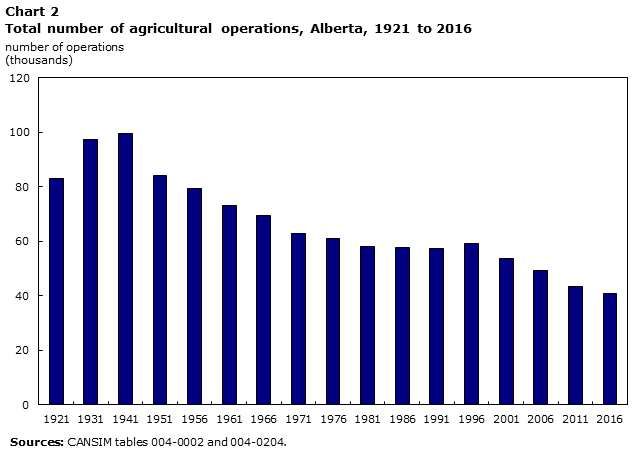
Data table for Chart ii
| Yr | Number of operations (thousands) |
|---|---|
| 1921 | 82,954 |
| 1931 | 97,408 |
| 1941 | 99,732 |
| 1951 | 84,315 |
| 1956 | 79,424 |
| 1961 | 73,212 |
| 1966 | 69,411 |
| 1971 | 62,702 |
| 1976 | 61,130 |
| 1981 | 58,056 |
| 1986 | 57,777 |
| 1991 | 57,245 |
| 1996 | 59,007 |
| 2001 | 53,652 |
| 2006 | 49,431 |
| 2011 | 43,234 |
| 2016 | xl,638 |
| Sources: CANSIM tables 004-0002 and 004-0204. | |
Alberta leads in beef
Once again, Alberta had the near cattle in Canada in 2016, accounting for 41.6% of the national herd. Alberta'southward feeder cattle (steers and heifers for feeding or slaughter) accounted for 59.six% of the national total, while its beef breeding stock (beef cows and heifers for beef herd replacement) accounted for 42.3%.
For the first time since the 2001 Census, Alberta reported an increase in the number of beefiness cattle (beef cattle for breeding and beefiness cattle for feeding/slaughter). This contrasted with the continued decline at the national level (-ii.4%). Alberta's beef cattle inventories rose ane.iii% from 2011 to 3.34 million caput — despite fewer farms (-9.0%) reporting beef cattle. Close proximity to processing capacity and availability of feed and pasture land provide Alberta'south beef sector with a comparative advantage over other provinces. In addition, volatility in the beef sector from 2011 to 2016, partially due to cost fluctuations, may have affected beef cattle inventories.
The number of dairy cows in Alberta decreased 0.8% from 2011 to fourscore,014 head in 2016, while the number of farms reporting dairy cows declined past 12.half dozen%.
While at that place were fewer dairy cows, this was offset past increased production per animal, owing to improved brute diet, genetics and production practices. Annual milk production increased eleven.0% to 732.3 million litres from 2011 to 2016 (CANSIM table 003-0011, accessed April 25, 2017).
From 2011 to 2016, the number of pigs in Alberta rose by 4.six% to 1.5 million head, while the number of farms reporting pigs increased 41.3%. The growth was due to improve market place atmospheric condition, which boosted the toll of pigs relative to the period preceding the last demography. Prior to the 2011 Census of Agriculture, the squealer sector had been aggress past high feed costs, disease and low pig prices, resulting in significantly fewer farms and a smaller squealer herd (CANSIM tabular array 002-0068, accessed April 25, 2017).
Total farm area down, but cropland upwards
Alberta reported the second largest total farm area over which farmers had stewardship in 2016, post-obit Saskatchewan. The total subcontract area in Alberta declined 0.v% from 2011 to 50.3 million acres in 2016. This decrease came about as the sector shed lower quality and non-agricultural lands and upgraded or divested mostly less productive pasture lands.
Start of text box
Total farm expanse, which is land owned or operated by an agricultural performance, includes:
- cropland;
- summerfallow;
- improved and unimproved pasture;
- woodlands and wetlands;
- all other country (including idle state, and land on which subcontract buildings are located).
End of text box
While the full farm expanse fell, the boilerplate farm size grew from 1,168 acres in 2011 to one,237 acres in 2016 and the expanse of cropland increased by 4.8% to 25.iii meg acres. This five-year period saw shifts of expanse away from hay to field crops.
| Component of cropland | 2011 | 2016 |
|---|---|---|
| Percent of cropland Table 1 Note1 | ||
| Field crops | 78.6 | 83.2 |
| Hay | 21.3 | sixteen.7 |
| Others Table 1 Annotation2 | 0.1 | 0.1 |
| Total cropland | 100.0 | 100.0 |
| ||
Canola is the leading crop
Oilseed and grain type operations accounted for roughly i-3rd of farms in the province. Canola remained the leading field crop past area reported in Alberta in 2016, followed by spring wheat and barley. Alberta ranked second in terms of field crop expanse.
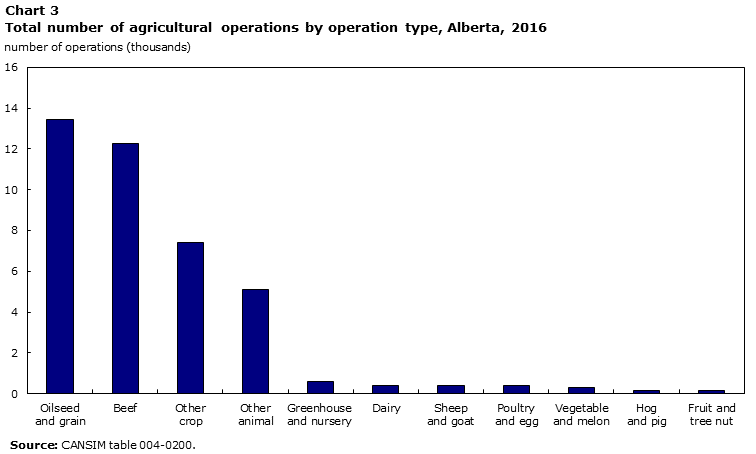
Data table for Chart 3
| Performance type | Number of operations (thousands) |
|---|---|
| Oilseed and grain | 13,451 |
| Beefiness | 12,282 |
| Other crop | vii,414 |
| Other animal | five,101 |
| Greenhouse and nursery | 605 |
| Dairy | 411 |
| Sheep and goat | 399 |
| Poultry and egg | 373 |
| Vegetable and melon | 299 |
| Pig and sus scrofa | 166 |
| Fruit and tree-nut | 137 |
| Source: CANSIM table 004-0200. | |
| Field crop | 2011 | 2016 |
|---|---|---|
| Acreage | ||
| Canola | half dozen,071,744 | 6,165,746 |
| Spring wheat | 5,971,359 | five,728,527 |
| Barley | 3,610,111 | 3,413,856 |
| Source: CANSIM table 004-0213. | ||
Area planted with sugariness corn down past over one-third
The full field vegetable area in Alberta decreased 5.7% from 2011 to 10,108 acres in 2016, due in large part to a reject in sweetness corn. Surface area planted with sweet corn has fallen by 38.4% since 2011 to two,475 acres. Equally a upshot, sweet corn fell to second, passing the leading spot in field vegetable area to greenish peas (3,721 acres).
The full expanse of state defended to fruits, berries and nuts production declined 17.1% to ii,164 acres. The leading fruit crops in 2016 were Saskatoon berries (one,314 acres) and strawberries (205 acres).
The area dedicated to greenhouse bloom and vegetable production rose 8.6% from 2011 to 12.0 million square feet in 2016. Greenhouse area dedicated to vegetable production increased by viii.5%, while expanse dedicated to greenhouse flowers grew by eight.7%.
Alberta'due south beekeepers reported the highest number of honeybee colonies in Canada. From 2011 to 2016, the number of honeybee colonies in Alberta increased 29.2% to 304,846. Alberta deemed for 39.v% of national honeybee colonies.
Alberta has the second highest proportion of female operators
There were 57,605 subcontract operators in Alberta in 2016, downwards 7.2% from 2011 and exceeding the decline in the number of farms (-6.0%).
Alberta had the second highest proportion of female operators in 2016, post-obit British Columbia. Women deemed for 30.8% of farm operators in Alberta, up from 29.0% in 2011. Nationally, women accounted for 28.seven% of farm operators.
From 2011 to 2016, the proportion of farm operators in the oldest age category (55 years and older) rose to 56.five%. The proportion of immature operators (nether 35 years old) rose to 8.5%. Over the 5-year menses, the average operator age rose from 54.5 years to 55.7 years.
| Age group | 2011 | 2016 |
|---|---|---|
| Percent of farm operators Table iii Note1 | ||
| Under 35 years erstwhile | 7.iii | 8.v |
| 35 to 54 years sometime | 43.i | 35.0 |
| 55 years and older | 49.6 | 56.5 |
| Total farm operators | 100.0 | 100.0 |
| ||
In 2015, 35.3% of farm operators in Alberta worked more than than 40 hours a calendar week on boilerplate on subcontract operations, compared with 37.8% in 2010. At the national level, this percentage was 37.five% in 2015.
Meanwhile, fewer farmers worked off the farm in 2015, with 47.3% of subcontract operators in Alberta reporting an off farm job compared with 52.0% in 2010. Nationally, 44.4% of farm operators worked off the farm. Despite the subtract, Alberta reported the second highest rate of off-farm work following British Columbia.
Gross farm receipts and operating expenses grow
Gross subcontract receipts reached $17.7 billion in 2015, while operating expenses totalled $15.0 billion. On boilerplate, for every dollar in gross farm receipts, farms in Alberta incurred 84 cents in operating expenses in 2015, down slightly from 85 cents in 2010.
The expense-to-receipt ratio varied amid farm types. In 2015, operations classified as dairy and milk had of the near favourable expense-to-receipt ratio at 0.75, a deterioration from 0.73 in 2010.
Start of text box
The expense-to-receipt ratio is the average amount of operating expenses incurred for a dollar in subcontract receipts. The ratio is calculated in current dollars.
Toll indices were used to obtain constant dollar estimates of receipts, expenditures and capital values in order to eliminate the touch of price changes in yr-to-yr comparison.
Census Day was May ten, 2016. Farmers were asked to written report their receipts and expenses for the terminal complete fiscal or calendar yr (2015).
Stop of text box
Other agronomics highlights in Alberta
- In Alberta, 4.seven% of farms reported having renewable free energy producing systems in 2015, compared with five.3% of farms nationally.
- In Alberta, 24.8% of farms were incorporated in 2016, up from 17.half-dozen% in 2011. Nationally, incorporated farms accounted for 25.1% of the total farms in 2016.
- The 2016 Census of Agronomics marked the first time farm operators were asked to report whether they had a written succession plan. In 2016, 8.v% of farms in Alberta had a written succession plan compared with 8.4% nationally.
- The proportion of farms producing organic products in Alberta edged up 0.ii per centum points to 1.0% in 2016. Nationally, farms producing organic products deemed for ii.two% of all farms in Canada in 2016.
- In Alberta, 25.7% of farms reported using automated steering applied science in 2015.
- In Alberta, 5.1% of farms reported selling agricultural products directly to consumers in 2015.
- The value of the land and buildings per acre in Alberta increased 26.five% (in 2016 abiding dollars) from 2011 to $2,354 in 2016. At the national level, this value was $ii,696 per acre.
Canada 150: Farming in Alberta
Alberta joined Confederation on September 1, 1905. In 1911, the outset census year in which the province of Alberta was included, there were 60,559 farms reported, 17.4 one thousand thousand acres of subcontract land and 739,725 cattle. In 2016, agricultural producers reported 50.iii meg acres of farm land and v.two million cattle, seven times more than in 1911.
Statistics Canada would like to thank the farming customs of Alberta for their participation and assistance in the 2016 Census of Agronomics.
Start of text box
Demography subcontract: An operation is considered a census subcontract (agricultural operation) if information technology produces at least one of the following products intended for auction:
- Crops: Hay, field crops, tree fruits or nuts, berries or grapes, vegetables, seed;
- Livestock: Cattle, pigs, sheep, horses, game animals, other livestock;
- Poultry: Hens, chickens, turkeys, chicks, game birds, other poultry;
- Beast products: Milk or cream, eggs, wool, furs, meat;
- Other agronomical products: Christmas copse, sod, greenhouse or plant nursery products, mushrooms, honey or bees, maple syrup and its products.
The information for Yukon and the Northwest Territories are non included in the national totals because of the different definition of an agricultural operation in the territories and confidentiality constraints. The information for Yukon and the Northwest Territories are presented separately.
Subcontract type: Farm type is established through a procedure that classifies each census farm according to the predominant type of production. This is done past estimating the potential receipts from the inventories of crops and livestock reported on the questionnaire and determining the product or group of products that make upwardly the majority of the estimated receipts. For case, a census farm with total potential receipts of lx% from hogs, 20% from beefiness cattle and 20% from wheat, would be classified every bit a pig and squealer farm. The subcontract types presented in this certificate are derived based on the 2012 Northward American Industrial Classification Organization (NAICS).
P.T.O. hp (Power Have Off horsepower): The measure of the ability available from a tractor engine to drive implements.
Gross subcontract receipts: The Census of Agriculture measures gross farm receipts for the calendar or accounting year prior to the demography. Gross farm receipts (before deducting expenses) in this analysis include:
- receipts from all agricultural products sold;
- plan payments and custom work receipts.
The following are not included in gross farm receipts:
- sales of forestry products (for example: firewood, pulpwood, logs, fence posts and pilings);
- sales of upper-case letter items (for example: quota, state, machinery);
- receipts from the auction of whatever appurtenances purchased simply for retail sales.
Full operating expenses: The Census of Agronomics measures operating expenses for the calendar or accounting year prior to the census. Total operating expenses include:
- any expense associated with producing agricultural products (such as the price of seed, feed, fuel, fertilizers, etc.).
The following are not included in total operating expenses:
- the purchase of state, buildings or equipment;
- depreciation or capital cost allowance. Depreciation represents economic "wear and tear" expense. Uppercase cost allowance represents the amount of depreciation written off past the tax filer as allowed by tax regulations.
2010 to 2015: Some information refer to a reference menses other than Census Twenty-four hours. For example, for financial data the reference menses is the agenda or accounting (fiscal) twelvemonth prior to the demography.
Subcontract operator: According to the demography, a farm operator is any person responsible for the management decisions made for an agricultural functioning as of May 10, 2016.
Finish of text box
Contact information
For more data, or to enquire near the concepts, methods or information quality of this release, contact us (toll-free 1-800-263-1136; 514-283-8300; STATCAN.infostats-infostats.STATCAN@canada.ca) or Media Relations (613-951-4636; STATCAN.mediahotline-ligneinfomedias.STATCAN@canada.ca).
Report a trouble on this page
Is something not working? Is at that place data outdated? Can't observe what you're looking for?
Please contact united states and permit us know how we tin assist you lot.
Privacy notice
- Date modified:
Source: https://www150.statcan.gc.ca/n1/pub/95-640-x/2016001/article/14808-eng.htm

Post a Comment for "Please Least in Order From Greatest to Least the Top 5 Beef Cow Producing States"